

AI integration in web and app development in 2025 operates on two distinct layers: process automation (code generation, testing, debugging, deployment) that accelerates developer workflows by 20–40%, and product intelligence (recommendation engines, chatbots, predictive analytics) that creates defensible, user-facing differentiation. Strategic adoption targeting high-friction workflows delivers measurable ROI; random tool adoption wastes budget and time.
- Two-layer model: Separate process automation (developer productivity) from product intelligence (user value) — both matter but require different investment decisions.
- Start narrow: Code assistants like GitHub Copilot or Cursor deliver ROI within weeks; expand to testing, monitoring, and deployment pipelines once baselines are established.
- Measure everything: Track cycle time, error rates, and user engagement before and after AI adoption — vague “AI strategy” without KPIs is a budget sink.
- Skill shift is real: Developer roles are moving from writing boilerplate to architecting AI workflows, prompt engineering, and managing ML models in production.
- Compounding advantage: Full-stack SaaS products that ship faster and embed AI features gain time-to-market, stickiness, and pricing power simultaneously.
What Is AI Integration in Web & App Development?
AI integration means embedding machine learning models, large language models (LLMs), and AI-powered automation into both the development process and the applications being built. The distinction matters enormously for prioritisation and budgeting.
A team that only uses AI to write code faster is leaving half the value on the table. A team that only ships AI features without improving its own velocity will be outpaced by competitors who do both. The most effective approach in 2025 treats these as complementary investment tracks, not alternatives.
Layer 1: Process Automation
(Developer Productivity)
Code Generation & Autocomplete
Automated Testing & QA
AI Debugging & Error Detection
Deployment & Infrastructure Monitoring
ships
faster
Layer 2: Product Intelligence
(User-Facing Features)
Recommendation Engines
Conversational AI & Chatbots
Predictive Analytics
Personalisation & AI Search
Both layers compound: faster dev cycles ship smarter products sooner.
Layer 1: Process-Level AI — Accelerating Developer Workflows

Process-level AI targets the repetitive, high-friction tasks inside the software development lifecycle. The goal is not to replace developers but to eliminate the low-value work that consumes 30–50% of engineering hours.
Code Generation & Autocomplete
Tools like GitHub Copilot, Cursor, and Claude (Anthropic) predict and generate code snippets, complete functions, and draft entire modules from natural-language prompts. In practice, developers building a REST API endpoint can auto-generate CRUD operations, authentication middleware, and error handling — tasks that typically consume 2–4 hours per endpoint.
Real-world benchmark: A fintech startup reduced API development time from 6 weeks to 3.5 weeks by rolling out Copilot across a 12-person team. The productivity gain was concentrated in boilerplate-heavy backend work, not architecture or business logic.
In 2025, agentic coding tools — including Devin 2.0, OpenAI’s o3-powered Codex CLI, and Cursor’s Composer Agent — can scaffold entire features autonomously. They still require senior developer review before merging, but the skill shift is clear: from writing code to reviewing and directing AI-generated code. Developers who understand this transition can command significantly higher rates by positioning themselves as AI workflow architects rather than line-level coders.
Automated Testing & QA
AI-driven test generation, visual regression detection, and log anomaly detection reduce manual QA cycles significantly. Tools like Testim, Applitools, and Mabl use computer vision and ML to detect UI changes across browsers and devices without hand-written assertions.
Case study: A B2B SaaS company cut QA cycle time from 10 days to 3 days after implementing AI-powered visual testing. The biggest gain was in regression coverage — AI tools caught 94% of visual regressions that manual testers had historically missed on mobile viewports.
Beyond visual testing, tools like CodiumAI and Diffblue Cover generate unit tests directly from source code, covering edge cases a human tester might overlook. This is especially valuable when shipping fast-iteration SaaS features where test coverage typically lags behind feature development.
AI Debugging & Error Detection
Platforms like Sentry and Datadog now use ML to cluster similar errors, surface root causes, and recommend fixes — reducing mean time to resolution (MTTR) by 40–60%.
When a production database query timeout occurs, Sentry’s AI can surface similar errors from the past 30 days, highlight the most common fix, and suggest schema optimisation steps — all before a developer has opened a terminal. Datadog’s Watchdog feature correlates anomalies across logs, metrics, and traces to identify cascading failures before they escalate.
Deployment & Infrastructure Monitoring
Platforms like Vercel, Railway, and AWS CodeGuru use AI to optimise build times, predict deployment failures, and auto-scale resources based on real traffic patterns. Predictive alerts can flag a memory leak 2–3 hours before it causes downtime, giving teams time to deploy a fix without a formal incident.
For solo developers and small teams managing multiple client projects, this kind of proactive monitoring is transformative — it’s the equivalent of having a dedicated DevOps engineer watching production 24/7. Pairing these tools with a structured solo dev practice and systems approach compounds the efficiency gains.
Layer 2: Product-Level AI — Building Intelligent Features
Product-level AI embeds intelligence directly into the application, creating user-facing features that drive engagement, retention, and revenue. This is where AI becomes a competitive moat rather than a cost-saving tool.
Recommendation Engines
Collaborative filtering and content-based models power product recommendations, content feeds, and “next best action” suggestions. For e-commerce SaaS, recommendation engines typically lift average order value (AOV) by 10–30% and reduce bounce rates by surfacing relevant inventory.
Services like AWS Personalize and Google Recommendations AI allow teams to deploy production-grade recommendation systems without building ML infrastructure from scratch. In 2025, these managed services have become significantly more accessible — a small team can integrate real-time personalisation via API in under a week.
Conversational AI & Chatbots
LLM-powered chatbots built on OpenAI GPT-4o, Anthropic Claude 3.7 Sonnet, or Google Gemini 2.0 handle support queries, onboarding flows, and in-app assistance. The key differentiator in 2025 is Retrieval-Augmented Generation (RAG) — connecting LLMs to your own product documentation, knowledge base, and user data to produce accurate, context-aware responses rather than generic hallucinations.
Concrete implementation: A SaaS onboarding chatbot using RAG over product docs reduced support ticket volume by 38% within 60 days of launch at a project management startup. The bot handled tier-1 queries (“How do I set up webhooks?”) autonomously, freeing the support team for complex issues.
Frameworks like LangChain, LlamaIndex, and Vercel AI SDK have matured significantly, making RAG pipelines achievable without a dedicated ML engineer.
Predictive Analytics
Churn prediction, lead scoring, and demand forecasting models give SaaS products a data advantage that compounds over time. The more user data a product accumulates, the more accurate its predictions — creating a flywheel that’s difficult for competitors to replicate quickly.
Tools like Mixpanel (with its Spark AI layer), Amplitude, and Heap now surface predictive insights without requiring custom model training. For teams that want more control, BigQuery ML and AWS SageMaker allow training on proprietary datasets.
AI-Powered Search & Personalisation
Semantic search — powered by vector embeddings rather than keyword matching — dramatically improves in-app search relevance. Tools like Algolia NeuralSearch, Typesense, and Pinecone (as a vector database) enable search that understands user intent, not just exact terms.
Personalisation engines that adapt UI layout, content order, and feature visibility based on user behaviour patterns are becoming a standard expectation in competitive SaaS categories. Products that still show the same interface to every user regardless of usage patterns are leaving retention gains on the table.
AI Tool Comparison: Process vs. Product Layer
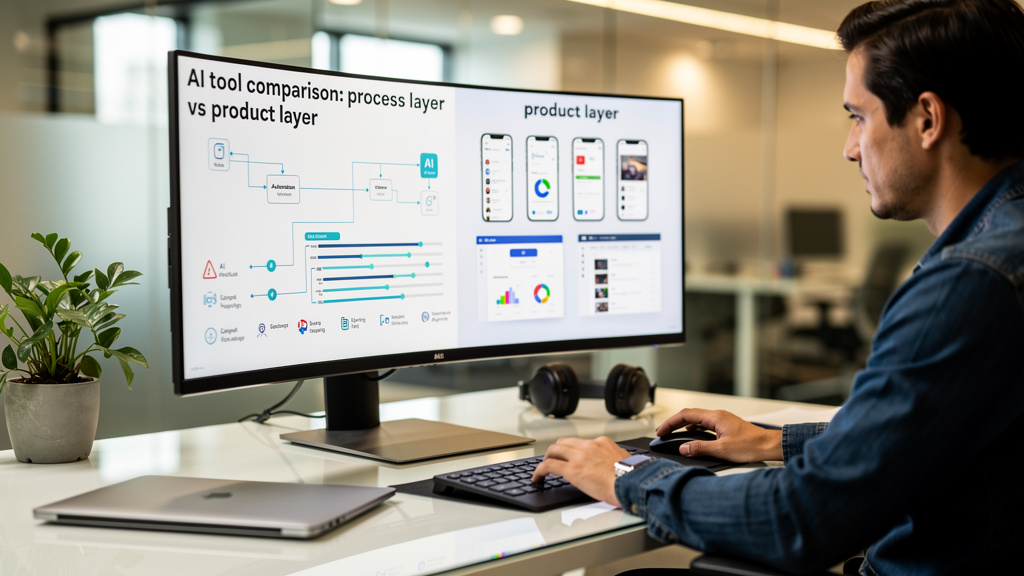
| Tool / Platform | Layer | Primary Use Case | Pricing Model (2025) | Best For |
|---|---|---|---|---|
| GitHub Copilot | Process | Code generation & autocomplete | $10–$19/user/mo | Teams on GitHub, all stack sizes |
| Cursor | Process | AI-native IDE, agentic coding | $20/user/mo (Pro) | Solo devs & small teams wanting full agent control |
| Testim / Mabl | Process | AI-driven test generation & regression | Custom / usage-based | SaaS teams with fast release cycles |
| Sentry (AI features) | Process | Error clustering, root cause analysis | Free tier + $26/mo+ | All team sizes in production |
| Datadog Watchdog | Process | Anomaly detection, predictive alerts | Usage-based (~$15/host/mo) | Mid-to-large teams, multi-service architectures |
| AWS Personalize | Product | Recommendation engine | Usage-based (per inference) | E-commerce SaaS, content platforms |
| OpenAI GPT-4o API | Product | Chatbots, RAG, content generation | $5/1M input tokens | Any product needing LLM features |
| Anthropic Claude 3.7 | Product | Long-context reasoning, RAG, agents | $3/1M input tokens | Complex reasoning, large document RAG |
| Algolia NeuralSearch | Product | Semantic in-app search | From $0.50/1K searches | E-commerce, SaaS with large content libraries |
| Pinecone | Product | Vector database for embeddings/RAG | Free tier + $70/mo+ | Teams building RAG pipelines |
Implementation Roadmap: Where to Start
The most common mistake is trying to implement everything at once. A phased approach reduces risk and builds internal confidence before scaling investment.
Phase 1
Code Assistant
Weeks 1–4
Phase 2
AI Testing & Monitoring
Months 2–3
Phase 3
First AI Feature
Months 3–5
Phase 4
AI-Native Product
Month 6+
Each phase builds on the last — measure ROI before expanding investment